Jul 27, 2026 @ 11:15
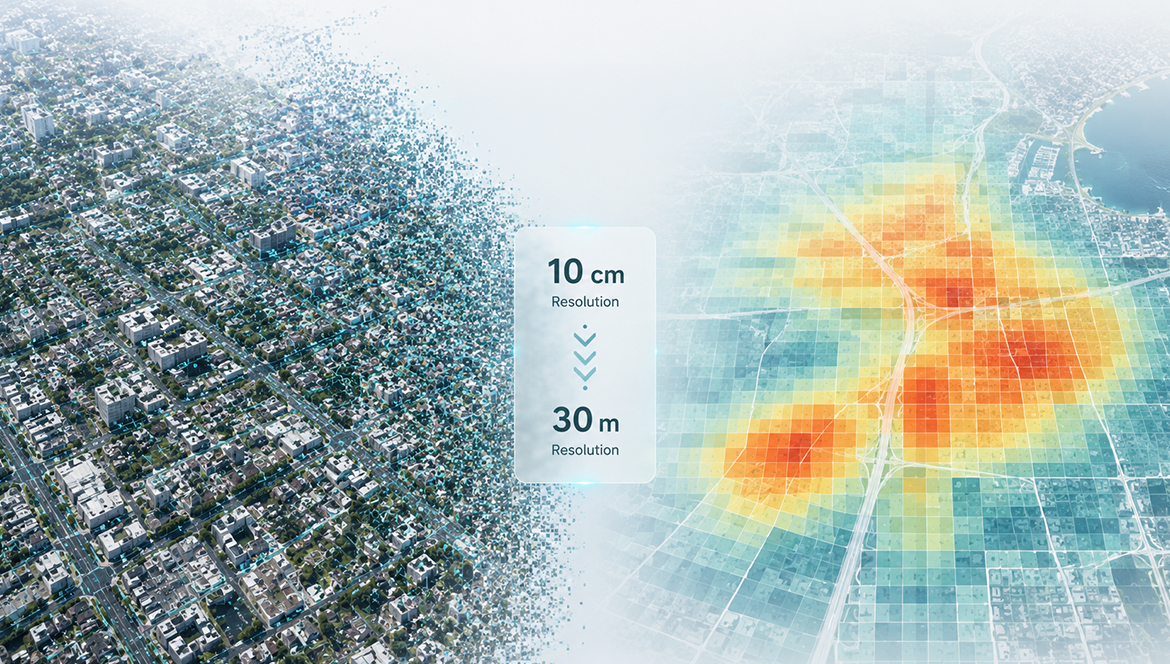
- by adminTGXThe Illusion of Density: How the “More Data” Trap Hijacks Enterprise GeoAI Decisions
We live in an era where we are conditioned to believe that more is always better. In the rapidly evolving fields of spatial data science and geospatial artificial intelligence (GeoAI), this bias is incredibly prevalent. When it comes to data, our instincts tell us that higher resolution, tighter focus, and sharper detail will naturally lead […]
Read more
Jul 27, 2026 @ 11:05
- by Premkumar SThe Dry Island Paradox: Uncovering Non-Linear Anomalies in Neighborhood Risk Scores (NRS)
In traditional climate risk modeling, stakeholders often default to a linear assumption: x inches of sea-level rise (SLR) equates to y dollars in localized damage. However, deep cross-data analysis of the Florida buildings dataset specifically tracking the Neighborhood Risk Score (NRS) and its dispersion (NRSD) across multiple decades and NOAA SLR scenarios reveals that climate […]
Read more
Jun 18, 2026 @ 14:54
- by adminTGXThe Repeatability Gap: Why GIS Professionals Rebuild Instead of Reuse
Geospatial analysis is an inherently complex science, requiring deep domain expertise to interpret the physical world. Yet, if you audit the daily workflow of an average GIS professional, you will uncover a frustrating paradox: a staggering portion of their time is spent executing routine, highly repeatable operations includes: Data ingestion, Coordinate Reference System (CRS) harmonization, […]
Read more
Jun 11, 2026 @ 11:04
- by Premkumar SModeling Compound Climate Hazards: The Statistical Reality of Non-Stationary Flood Risk
In the domain of predictive climate modeling, the assumption of stationarity, the idea that natural systems fluctuate within an unchanging envelope of variability, has entirely broken down. Historically, coastal risk models have relied on univariate, deterministic projections of baseline Sea Level Rise (SLR). However, from a rigorous data science perspective, treating SLR in isolation introduces […]
Read more
May 7, 2026 @ 13:39
- by adminTGXWhy You Should Stop Writing Python for GIS (And Start Orchestrating Logic)
For the better part of the last decade, the geospatial industry has aggressively pushed a single, seemingly foolproof solution to overcome the limitations of desktop software: “Learn Python.” The promise was intoxicating. By mastering Python for GIS, analysts were told they could finally escape the manual, repetitive clicking of the desktop user interface. They could […]
Read more